Topology should not be a prerequisite
You should be able to search a corpus without first designing a cluster to hold it. Adding capacity should be starting a process, not planning a migration.
Gnarl is built by Lucenia. We have spent a long time building distributed search for organizations whose data was never going to fit in one place — and we got tired of pretending it would.
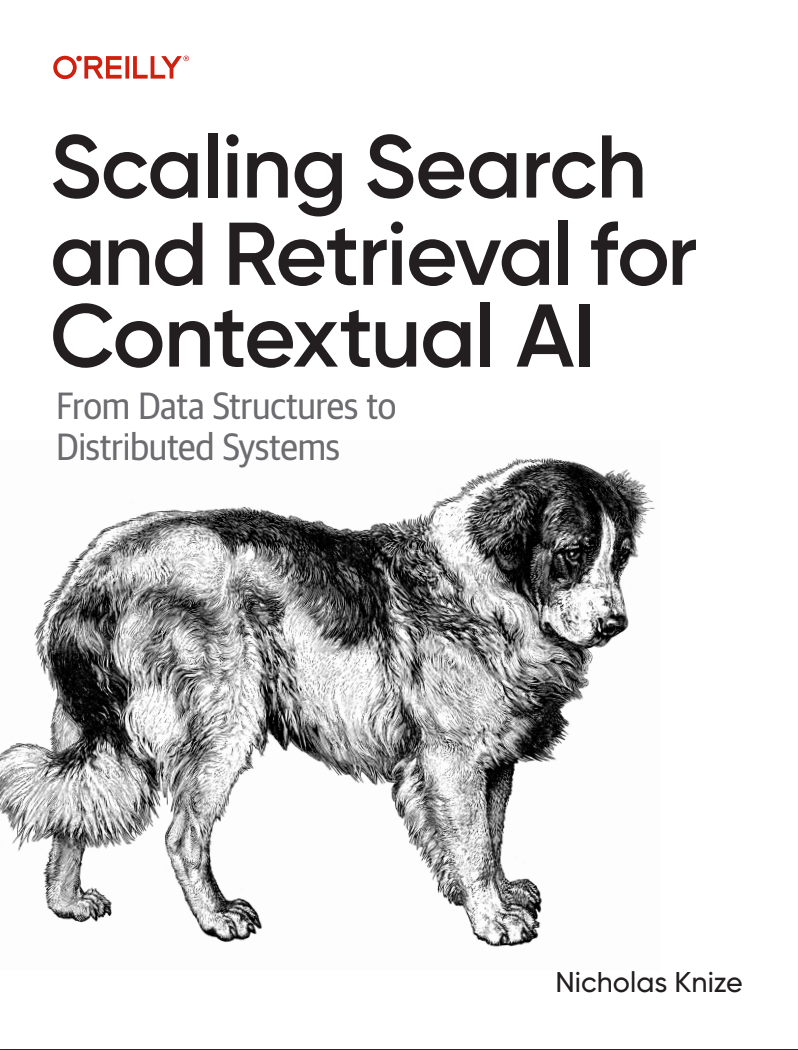 Published by O’Reilly Media
Lucenia was founded by Nicholas Knize — search infrastructure engineer, holder of eight patents in search and information retrieval, and author of the O’Reilly guide to scaling search and retrieval for contextual AI. Gnarl is the part of that work that would not fit inside a cluster.
You should be able to search a corpus without first designing a cluster to hold it. Adding capacity should be starting a process, not planning a migration.
Copying an archive somewhere else in order to ask it a question is a workaround we all stopped noticing. It is expensive, it is slow, and increasingly it is not allowed.
A distributed system that hides which parts did not respond is lying by omission. Coverage belongs in the response, where the caller can act on it.
A phone in the field holds data a datacenter never will. If it can index and answer, it is a peer — not a client waiting for a server.
Lucenia builds search and retrieval infrastructure for organizations with more data than any single system was designed to hold — geospatial archives, regulated corpora, and the retrieval layer under contextual AI. Gnarl is Lucenia’s decentralized network layer: the same retrieval engineering, without the requirement that everything end up in one place first.

The future of search isn’t bigger clusters. It’s smarter networks.
If your data is somewhere it cannot leave, we would genuinely like to hear about it — that is the case Gnarl exists for.